

Older People Surpass The Young In The World For The First Time In History: Report
There are now more seniors in the world than young children. The world will only get grayer as more time goes by, according to a U.S. Census Bureau report.


There are now more seniors in the world than young children, and the world will only get grayer as more time goes by, according to a U.S. Census Bureau report.
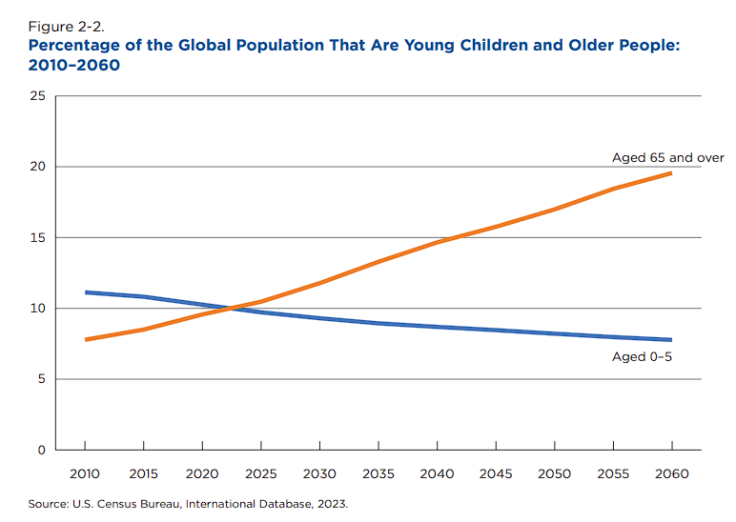
The study, called An Aging World: 2025, found that global demographics are rapidly changing, with the world becoming older fast. In fact, for the first time in history, the share of people older than 65 surpassed the number of people five or younger last year.
"This is the first time this 'crossing' of the youngest and oldest age groups has happened in human history and is projected to drastically widen in the coming years," the report states. "The share of the population aged 65 and over is projected to nearly double, from 10.5 percent (about 1 in 10 people) in 2025 to 19.6 percent (about 1 in 5 people) by 2060."
The report also notes that because women statistically live longer than men, the share of older women as a part of the population will rise.
The world is expected to add another 2 billion people from 2025 to 2060, increasing global population from around 8 billion to around 10 billion. However, the demographic that will see the largest growth is the 65 and older category.
"Over one-half of that growth (1.148 billion) is projected to come from an increase in the population aged 65 and over," the report states. "By contrast, the population at younger ages (age 0–19) is projected to stay relatively constant due to persistent low fertility. As the size of the older population grows rapidly and the youthful age population remains roughly the same, the percentage of the population aged 65 and over is projected to increase."
The report notes that the birthrate in 71 percent of countries is now below the replacement level of 2.1. China, in particular, has seen its birthrate plummet.
In 2023, birth rates per woman in China hit 1.06. The report states that China's birth rates is now "among the very lowest in the world and a level unthinkable a decade ago for a middle-income country. Based on the experiences of other countries with super-low fertility, few observers expect China's...to return to the relatively stable levels observed from 2000–2020 (typically between 1.5 and 1.6), let alone return to replacement level at 2.1 births per woman."
Aside from lower birth rates, the fact that people are living longer is one of the primary driving factors. The report notes that people are also living a healthier, more active life for a longer time.
"With few exceptions, population health across the globe is improving on average, with mortality rates dropping in all age groups including older ages," the report states.
© Copyright IBTimes 2026. All rights reserved.