

The Second Largest U.S. Reservoir Hits Lowest Level Ever. It Is Close To Not Being Able To Generate Power.
Lake Powell, which is part of the crucial Colorado River system, has fallen to 3,519 feet.

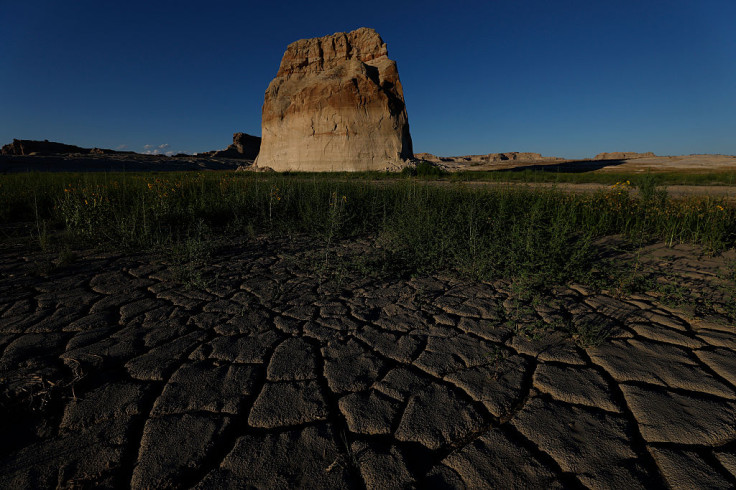
The second-largest reservoir in the U.S. has fallen to a record low water level.
Lake Powell, which is part of the crucial Colorado River system, has fallen to 3,519 feet. According to PBS, this is the lowest level ever for the lake, breaking a previous low water mark set in April 2023.
If the water level falls another 30 feet, the reservoir would no longer have the ability to generate electricity. According to the Lake Powell Water database, the lake has lost about two feet since August 3. Over the last 12 months, it has lost about 31.5 feet.
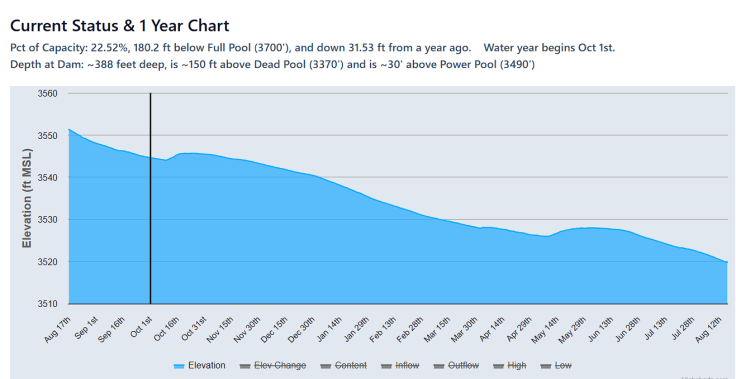
CNN noted that the reservoir generates enough power every year to power 500,000 homes. The minimum depth needed to generate power is 3,490 feet.
Brad Udall, a senior water and climate research scientist at Colorado State University, told the outlet that he thought that this "scary threshold" could be reached later this year without "extraordinary measures" being taken.
The Colorado River system is relied upon by California, Arizona, Nevada, New Mexico, Utah, Wyoming, and Colorado. The Colorado River Compact of 1922 divided up water use of the river between the upper basin and the lower basin.
According to the California Institute of Public Policy, the river provides water to nearly 40 million people and provides irrigation to 5.5 million acres of farmland. In the upper basin, Colorado and Utah are the biggest water users, using 23 percent and 10 percent of the water respectively. In the southern basin, California and Arizona are the biggest users at 27 percent and 17 percent, respectively.
"California's share of the Colorado River irrigates approximately 770,000 acres and supplies water to more than 20 million people," the institute stated.
Since 2000, the river has faced droughts and overuse. The river is dependent on snowfall in the Rocky Mountains. Less snowfall means lower river levels. However, usage of the river has not changed with less snowfall.
"For the past 25 years, Colorado River water use has exceeded the river's annual supply by an average of 1 million acre-feet per year," the institute stated.
Lake Powell separates the upper basin of the river from the lower basin. If the reservoir were to drop to a level of 3,370 feet, no water would be able to flow downstream from the dam at all, according to CNN.
Jack Schmidt, director of the Center for Colorado River Studies at Utah State University, told CNN that he would expect drastic action before that happened. "I would expect draconian steps to decrease water use to prevent this from occurring. But who knows?"
© Copyright IBTimes 2026. All rights reserved.