

Why On-Chain Options Are Ready for Their Breakout Moment
Crypto has never had a demand problem for derivatives. Traders have shown an extraordinary appetite for leverage, hedging and asymmetric exposure, yet while perpetual futures have become one of the largest markets in digital assets, on-chain options have repeatedly struggled to achieve meaningful scale. The reason was not lack of demand. Options arrived before the infrastructure required to support them, and that is what has changed.
Deeply liquid on-chain perpetual markets now provide options market makers what they need to hedge efficiently, portfolio margin is making capital dramatically more productive, tokenization is expanding the universe of assets that can support derivatives, and consumer trading interfaces have demonstrated that sophisticated financial products do not need to feel sophisticated to the person using them.
The size of the opportunity is already visible in traditional markets. U.S. listed options traded an average of $36.8 billion in premium and approximately $4 trillion in notional value per day in 2025. It was also the sixth consecutive record year for the U.S. listed options industry, a clear indication that investor demand for options continues to accelerate. The infrastructure for bringing that demand fully on-chain is ready now.
Why the first generation of crypto options failed
An options exchange is considerably harder to build than a perpetual-futures venue. When a market maker sells an option, it must manage changing exposure to price, volatility and time while continuously hedging the underlying position, which requires deep liquidity in the underlying perpetual market and the ability to deploy collateral across positions without excessive friction. Earlier decentralized options protocols were attempting to solve this problem before those foundations existed. Without deep perpetual or spot markets for hedging, market makers faced higher costs of capital and greater execution risk, which translated into wider spreads and worse prices for traders. Worse pricing suppressed activity, making the market even less attractive to liquidity providers and creating a structural problem that marketing alone could not solve.
The products themselves also tended to reproduce the experience of a professional options terminal. Strike grids, Greeks and volatility metrics may be essential tools for sophisticated traders, but they are not how most consumers naturally think about making an investment. Robinhood showed the traditional market that the financial instrument itself does not have to become less sophisticated; the experience of expressing the trade does. On-chain markets are now positioned to combine that simpler user experience with an underlying market structure that earlier options protocols did not have.
The missing infrastructure now exists
The most important development in crypto derivatives over the past several years is the emergence of deep, continuously operating underlying markets. Hyperliquid is perhaps the clearest example, having created substantial perpetual-futures liquidity across a broad universe of assets and giving options market makers something earlier decentralized venues largely lacked: a deep market against which they can continuously hedge their exposure. Portfolio margin is the second major unlock. Instead of forcing every position to be collateralized as though it exists independently, portfolio margin allows related positions to offset one another. An options market maker selling calls while hedging through perpetual futures can therefore deploy capital considerably more efficiently, changing the economics of operating an options market.
This is where newer venues such as Hypercall become important. Rather than trying to bootstrap an options exchange and its underlying hedging market simultaneously, they can build directly on top of established derivatives infrastructure and connect the two. That architecture creates a powerful liquidity flywheel. More efficient hedging enables market makers to quote tighter spreads, better prices attract more traders, and more trading produces deeper options books that support additional strikes and expirations. Greater liquidity then attracts more market makers, reinforcing the market rather than forcing every new participant to solve the same bootstrapping problem from scratch.
This dynamic also explains why successful options exchanges become extraordinarily difficult to displace. Long-dated positions keep collateral on a venue for weeks or months while new strikes and expirations continuously accumulate around them, so once significant open interest and liquidity become concentrated somewhere, that liquidity becomes its own competitive advantage. The first generation of on-chain options exchanges had to manufacture that flywheel from almost nothing; the next generation begins with a liquid derivatives ecosystem already underneath it.
Options solve something perpetual futures cannot
There is also a fundamental product reason to believe options can become significantly larger on-chain. Perpetual futures provide straightforward leveraged exposure, but that leverage comes with liquidation risk. A trader can be correct about where an asset will ultimately trade and still lose the position because the market moved sharply in the wrong direction first.
For the buyer of an option, the structure is different because the maximum loss is established when the trade is opened: the premium paid. That does not make options risk-free, since an option can expire worthless and volatility, pricing and time decay all matter enormously. But an options buyer cannot be forcibly liquidated simply because an asset moves against the position before the thesis ultimately plays out.
Traditional markets are already demonstrating how powerful that proposition can be for individual investors. Cboe reported that zero-day-to-expiration SPX options averaged 2.3 million contracts per day in 2025 and accounted for 59% of all SPX options volume. Cboe has also estimated that retail investors account for roughly 50% to 60% of SPX 0DTE trading, showing how rapidly a product once associated primarily with professional derivatives desks has moved into the investing mainstream.
That does not mean every retail investor should trade short-dated options. It does demonstrate that defined-risk, event-driven exposure has enormous consumer appeal when the interface around it is accessible, and there is no reason to assume that appetite disappears when the financial rails move on-chain.
The underlying asset universe is exploding
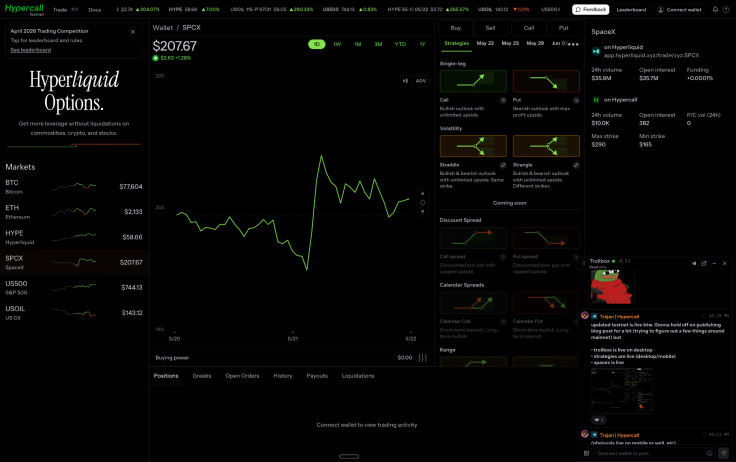
The other major shift is tokenization. Traditional options markets tend to form around a relatively narrow universe of sufficiently liquid stocks, indexes and commodities, while programmable financial markets have the potential to expand that universe much more rapidly. As equities, commodities, indexes and private-market exposures move on-chain, an options layer connected to those markets can move with them. Hypercall's options tied to tokenized SpaceX exposure illustrate what this looks like in practice. The significance is larger than SpaceX itself because it demonstrates how an on-chain options venue can create derivatives exposure around assets that historically have had little or no accessible retail options market.
Extend that model across private companies, emerging public-market assets, commodities and crypto-native instruments, and the addressable market becomes considerably larger than "crypto options." It becomes a global market for defined-risk exposure to virtually anything that can trade on-chain.
There are still real challenges. Liquidity has to be earned, market makers need attractive economics, and tokenized real-world assets introduce important questions around settlement, pricing and regulation. A platform capable of listing an option is not automatically a platform capable of supporting a deep market in it, but these are now execution challenges inside an infrastructure that exists rather than fundamental pieces of infrastructure that still need to be invented.
Options are the next phase of 24/7 finance
The broader direction of financial markets is increasingly clear. Crypto established the expectation that markets can operate continuously, traditional brokers and exchanges are extending trading beyond conventional hours, and tokenization is making financial assets increasingly portable across new infrastructure. Capital is becoming more global, programmable and always available, and the derivatives layer is the logical next step.
Previous decentralized options markets were trying to build one of finance's most sophisticated products on top of an immature financial system. Today's market has deep underlying derivatives liquidity, increasingly efficient portfolio margin, proven consumer trading interfaces and a rapidly expanding universe of tokenized assets. Those changes solve the structural problems that held the first generation back.
That is why the opportunity today is fundamentally different. On-chain options no longer need to prove that the infrastructure required for a serious market can exist; they need to prove how large a market that infrastructure can support. The next chapter of 24/7 finance will go far beyond allowing investors to buy an asset at midnight. It will be the emergence of a global derivatives market where anyone, anywhere can access defined-risk exposure to an expanding universe of assets—and the market never has to close.
About Duncan Reucassel
Duncan Reucassel has been investing in crypto for nine years. He attended McGill University before leaving after his second year to join Delphi Digital's research team, where he covered decentralized derivatives. He is now CIO of Triton Liquid Fund.
© Copyright IBTimes 2026. All rights reserved.