World in Transit Hides ‘Invisible’ Planet in Its Solar System [VIDEO]

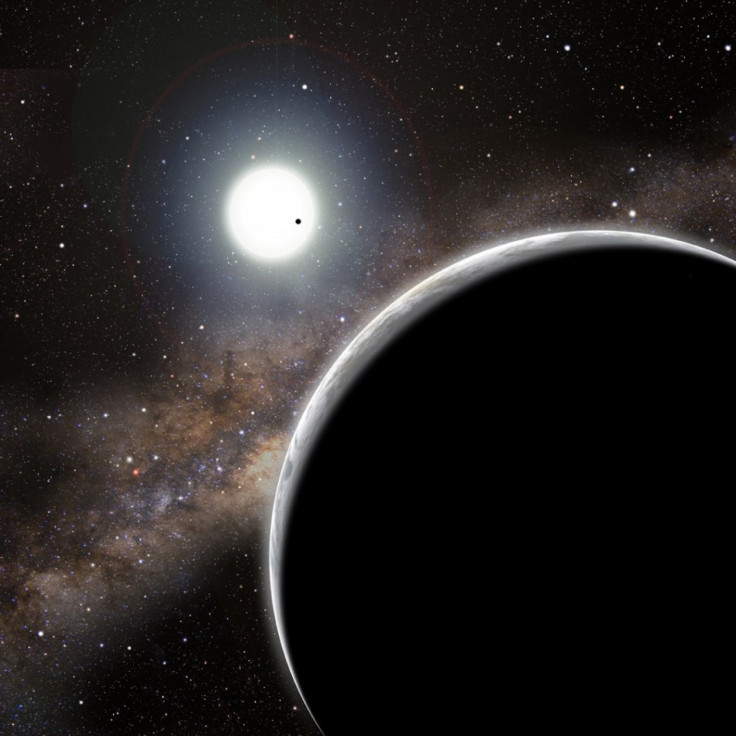
NASA's Kepler spacecraft spotted an 'invisible' planet that astronomers never glimpsed before.
Planet hunters say they eyed a world in transit around its star and found the invisible planet hiding somewhere in its solar system.
At this point, astronomers don't know anything about the invisible world Kepler-19c, other than that it exists.
The second planet is said to possess a different orbital tilt that made it otherwise undetectable to scientists.
Scientists say Kepler-19c, which comes after Kepler-19b, shows itself by the way it influences other planets through force, as the invisible planet tugs at the Kepler-19b, slowing it down and then speeding it up in its transition.
It's a mystery world, but of course we don't expect it to remain a mystery, study co-author David Charbonneau, told Space.com.
All the planets in our solar system orbit our sun on mostly the same plane.
But a new article in the Astrophysical Journals suggests that the worlds orbiting the star Kepler 19, don't.
This report was led by Sarah Ballard of the Harvard-Smithsonian Center for Astrophysics.
It's like having someone play a prank on you by ringing your doorbell and running away, Ballard said. You know someone was there, even if you don't see them when you get outside.
Kepler space telescope looks at more than 100,000 stars out to roughly 3,000 light years from Earth. It is always on the prowl looking for dips in starlight caused by transits of planets orbiting around them.
Kepler 19b orbits its star once about every 9 days and 7 hours. It also appears twice as big as Earth, which puts it in the realm of a mini-Neptune class planet. It orbits the star at a distance of 8.4 million miles, where it is heated to a temperature of about 900 degrees Fahrenheit.
Kepler-19b has a diameter of 18,000 miles.
Scientists discovered the planet Neptune in the same way when they were tracking Uranus and then noticed that its orbit didn't match predictions. They saw that a more distant planet might be nudging Uranus and calculated the expected location using telescopes.
This method holds great promise for finding planets that can't be found otherwise, said Harvard astronomer and co-author David Charbonneau.
The Kepler spacecraft will continue to monitor Kepler-19 throughout its mission with the aim of gathering more information about Kepler-19c.
Future ground-based instruments will also attempt to measure the mass of Kepler-19c.
© Copyright IBTimes 2026. All rights reserved.
- MOST POPULAR IN Science