

Florida Primary 2012 Results: What Romney’s Win Means
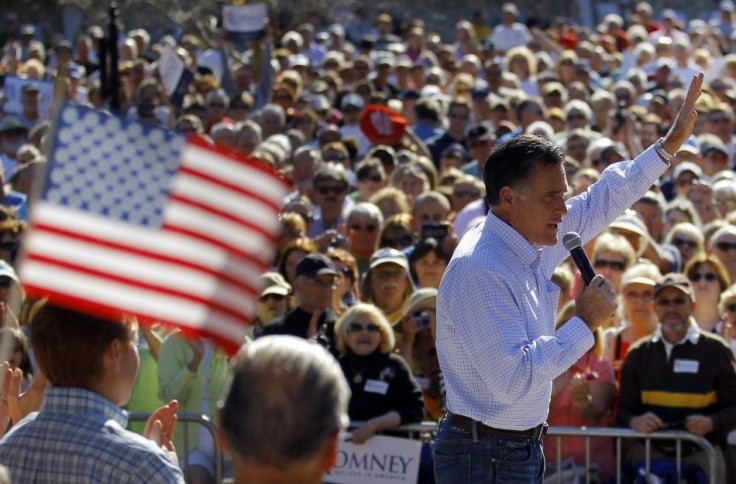
Mitt Romney has been declared the winner of the Florida primary, restoring much of the momentum he lost to Newt Gingrich in South Carolina.
With 96 percent of precincts reporting as of 10 p.m. EST, Romney had 46.4 percent of the vote, followed by Gingrich with 31.9 percent. Rick Santorum and Ron Paul trailed badly, with 13.4 percent and 7 percent, respectively. Now, with Florida's 50 delegates under his belt and a friendly calendar ahead -- Nevada, Colorado and Minnesota will all hold caucuses in the coming week, and polls show all three states leaning in his direction -- Romney is firmly back in the front-runner's seat.
It takes 1,144 delegates to win the Republican nomination, and only a small fraction of that total has been awarded so far. In that sense, there is plenty of time for one of Romney's opponents to upset him. But in practice, Romney has several advantages that will be very difficult for anyone else to overcome: an electable image, strong organization and almost limitless money.
Gingrich has been outspent 5 to 1 by Romney, the GOP establishment made it clear they regarded him as a potential landslide loser, and he also did poorly in both Florida debates, said Larry Sabato, director of the Center for Politics at the University of Virginia. This is a toxic combination.
Reclaiming Electability
Throughout the 2012 campaign, one of Romney's strongest arguments has been this: he may not be the unwavering conservative that the Republican rank and file is searching for, but he has the best chance of beating President Barack Obama come November. In other words, his opponents may be more ideologically pure, but they can't win.
Gingrich has fought mightily to reverse that perception, telling voters that the only way to defeat Obama is to nominate someone who presents a clear ideological contrast. As evidence, he points to the 1980 presidential election, when the conservative Ronald Reagan beat the moderate George H.W. Bush in the primaries and went on to claim a landslide victory over Democratic incumbent Jimmy Carter. And in South Carolina, Gingrich succeeded: among voters who cited electability as their primary concern, more voted for Gingrich than for Romney.
But Florida voters -- likely swayed by the Romney campaign's relentless attacks on Gingrich's past, both personal and professional -- didn't buy it, and Romney's victory here is the strongest statement yet that he alone holds the electability card with most voters.
Florida is by far the largest and most diverse state that has voted so far this year. Iowa, New Hampshire and South Carolina are small, and their Republican electorates are largely homogeneous. Evangelical Christians and social conservatives dominate Iowa and South Carolina, and they gave victories to Santorum and Gingrich, respectively. New Hampshire Republicans are more moderate, and they voted for Romney. Florida was the first test of the candidates' ability to appeal to many demographics at once, and in turn their ability to be competitive on the national stage.
It's certainly what the Republicans in Florida had intended to project by skipping ahead of the whole calendar, because Republicans here know that a Republican cannot win the White House without winning Florida, said Susan MacManus, a political scientist at the University of South Florida. They wanted to weigh in on the process earlier, so that sooner rather than later, these candidates had to campaign and appeal to a larger and more diverse audience.
Romney passed that test, and his victory here speaks volumes about his national viability, MacManus said.
On the other hand, Gingrich is undeniably better than Romney at generating enthusiasm for his candidacy. Even many of those who support Romney aren't excited about doing so, and that could be a handicap for Romney in the general election. The demographic breakdown of his support in Florida will give some indication of his national prospects.
Even if he wins handily [in Florida], if most of the Tea Party voters vote for Gingrich or Santorum, then it raises questions not so much about whether Romney would get their votes, but about how enthusiastic they would be, and whether as many Tea Partiers would get out to vote in the first place in the general election, said Richard Niemi, a political scientist at the University of Rochester. The Tea Partiers are not likely to vote for Obama over Romney, but they may or may not be excited enough to get out to vote in large numbers. While it [Florida] is a very good sign for Romney ... exactly what that means for his chances in November is really hard to say.
But despite the lingering questions about Romney's electability, Gingrich will have a hard time arguing post-Florida that he is stronger in that regard.
What Happened to Gingrich?
Following his spectacular upset in South Carolina on Jan. 21, Gingrich saw his poll numbers skyrocket in Florida. He went, practically overnight, from trailing Romney by double digits to leading him by double digits.
But then, over this past week, Gingrich's poll numbers fell back nearly to where they were before South Carolina, and despite a whirlwind campaign in Florida -- he visited five cities on Monday alone -- he was unable to recover. Why?
One of the biggest factors was that, for all his talk about uniting anti-establishment conservatives behind him -- something Santorum's continued candidacy has made very difficult -- Gingrich has succeeded in little but uniting the GOP establishment against him.
Gingrich likes to present his candidacy as the Republican establishment's worst nightmare, because he is the only candidate who would bring real change to Washington. And he is right that the establishment sees him as its worst nightmare -- but it's more because they fear that he couldn't bring real change to Washington, or even get there in the first place.
The establishment is terrified of Newt, said Charles Zelden, a historian at Nova Southeastern University in Fort Lauderdale, Fla. They're afraid of a nominee so out of touch that it's a landslide not just for the president but for his whole party. They learned their lesson with [Barry] Goldwater in 1964.
That message -- essentially, a Gingrich un-electability argument to complement the Romney electability argument -- seems to be resonating with voters.
It does tend to puncture a bit of the air out of Gingrich's electability balloon if he can't carry a state like this, when he still has to go through the Californias, the New Yorks, the Michigans, to amass the 1,144 delegates, MacManus said.
Then there were the debates.
In South Carolina, Gingrich pulled off his upset largely on the basis of two strong debate performances. Those performances catapulted him to victory in the Palmetto State and, coupled with his 12-point margin of victory, gave him a big bounce in the polls in Florida. But two comparatively weak debate performances this past week brought him just as quickly back to earth.
Romney didn't have to perform spectacularly in the Florida debates. He just had to keep pace with Gingrich, and he did.
Gingrich's only way of getting his word out is free media and the debates, Zelden said last Thursday. Yes, he's got a $6 million buy for ads playing in Florida, trashing Romney, but in terms of making a positive argument, this is where he's making it. But he's coming into these debates now as the favorite, which means everyone is now piling on him, and that gave room for Romney in the last debate to pull his own.
By doing so, Zelden said, Romney neutralized Newt's strongest weapon.
What Now?
Even the boldest prognosticators have grown leery of declaring Gingrich dead, because he was supposed to be dead in June and again after the New Hampshire primary, and both times he somehow came back. If anything, Gingrich seems to do best when he has been counted out.
Given that tendency, few people expect Gingrich to end his campaign after Florida, or anytime soon, for that matter. He will probably collect a good number of delegates as the race goes on, especially from the Southern states that vote on Super Tuesday, and that would allow him to wield some influence at the Republican National Convention in August, even if Romney got the nomination.
But that doesn't mean Gingrich will win, and whatever he says, Florida makes his chances a lot slimmer.
One or two strong performances in February, coupled with several wins on Super Tuesday, would keep him alive, Sabato said of Gingrich, but winning the nomination is probably a bridge too far.
Then there are Santorum and Paul, who finished far behind in Florida after choosing not to campaign much there. Can they keep going?
Santorum has said repeatedly that he will not drop out after Florida, despite what is looking like a distant third-place finish.
No matter what happens in Florida, this race is wide open. We plan on being in this campaign for a while, he told supporters on Tuesday in Colorado, which will hold its caucuses on Feb. 7. He joked about the volatility of the 2012 campaign, in which almost every candidate has spent some time as a front-runner: If you don't like the way the race is going now, he said, just wait a week or two.
But a hundred insistences that he will stay in the race don't mean he actually will. That much is clear from Michele Bachmann, who said after Iowa that there were many more chapters to be written on our path to the nomination before ending her campaign the next day, and from Rick Perry, who insisted he would compete through Super Tuesday but ended up dropping out before South Carolina.
Candidates never say ahead of an event like this that they're going to drop out, Niemi said. Whatever Santorum has said, that may change tonight or tomorrow or in the next couple of days.
He may keep his campaign going, though, if only to keep social issues in the national spotlight -- just as Ron Paul will almost certainly stay in the race to promote his libertarian views.
The debates give them a continual platform that gives them a lot of attention and keeps their particular issue priorities alive and well, MacManus said. There's no motivation, really, for them to get out, as long as you have the debates and the proportional allocation of delegates.
By refusing to end their campaigns, long-shot candidates like Santorum and Paul do run the risk of looking like spoilers: If it looks like you're just not going anywhere and you continue to be belligerent and harm the party's chances ... that reaches the point of diminishing returns, MacManus said.
But, she added, it's probably a long way yet before we reach that point.
© Copyright IBTimes 2026. All rights reserved.