

Bessent Wants a Global Response to China’s Export Boom, Tells G20 Countries to Reconsider Terms of Trade
Bessent argued that weakness in China's domestic economy has increased Beijing's reliance on exports, creating mounting pressure on other economies absorbing Chinese goods.

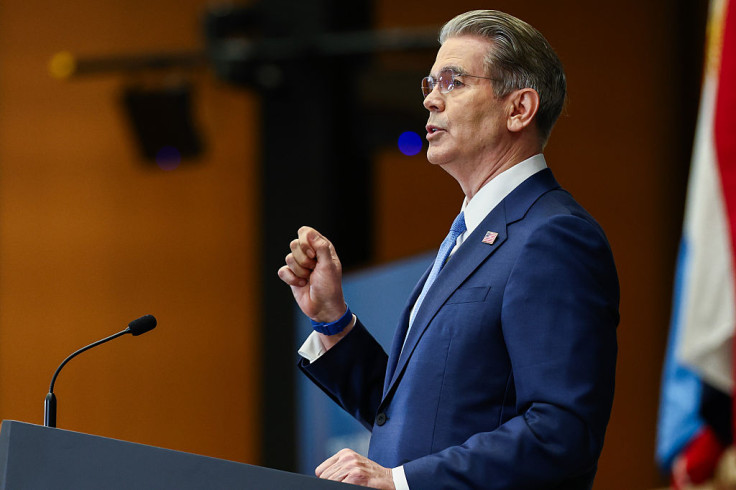
U.S. Treasury Secretary Scott Bessent is urging the world's largest economies to reconsider their trade relationships with China, arguing that Beijing's large export surplus has become unsustainable and may require additional trade barriers from countries beyond the United States.
Speaking to Reuters ahead of the meeting of G20 finance leaders in Asheville, North Carolina, Bessent said he plans to encourage member countries to examine their terms of trade with China as Washington pushes for a broader international effort to reduce global economic imbalances.
"The world cannot have a China with a $1.2 trillion trade surplus," Bessent told the outlet. He argued that weakness in China's domestic economy has increased Beijing's reliance on exports, creating mounting pressure on other economies absorbing the country's goods. The Trump administration has already erected substantial barriers against Chinese imports, including high tariffs and restrictions on certain products.
Those policies have contributed to a sharp decline in the bilateral trade deficit, but they have also helped redirect Chinese exports toward other markets, particularly Europe and Latin America. The U.S. goods trade deficit with China totaled about $73.9 billion during the first six months of 2026, down roughly one-third from the same period a year earlier, according to U.S. Census Bureau data. U.S. imports from China totaled approximately $129.3 billion during that period, compared with exports of about $55.5 billion.
Bessent said other countries now face their own decisions over how to respond to rising Chinese imports. "The rest of the world is going to have to examine their terms of trade with China," he told Reuters. Washington is seeking a G20 joint statement addressing trade and current account imbalances, an issue that has gained urgency as China's export machine continues to generate record surpluses.
The International Monetary Fund's 2026 External Sector Report found that global current account balances widened further in 2025, with China and the United States among the main drivers of excess imbalances.
Bessent, however, pushed back against arguments that exchange rates should be the primary tool for addressing the problem. Some European officials and economists have suggested coordinated action to strengthen China's yuan, reviving comparisons to the 1985 Plaza Accord, when major economies agreed on measures that helped weaken the U.S. dollar against other currencies.
Bessent called that approach misguided. He argued that China's excessive industrial subsidies and persistently weak domestic consumption are more fundamental problems than the currency itself.
The trade push comes just weeks before another potentially significant moment in U.S.-China relations. President Donald Trump is expected to meet Chinese President Xi Jinping at the White House in late September. Ahead of that summit, U.S. and Chinese officials are expected to continue discussions over potentially reducing tariffs on some non-strategic goods.
Bessent told Reuters there could be approximately $30 billion worth of non-strategic and non-critical goods on each side where tariffs could potentially be removed. The two countries are also discussing artificial intelligence safeguards designed to prevent powerful AI models from reaching non-state actors.
At the same time, Washington is rebuilding parts of Trump's tariff strategy following a Supreme Court decision that struck down broad duties imposed under emergency powers. The administration imposed a 12.5% tariff on Chinese imports in July following a forced-labor trade investigation and is preparing potential additional measures tied to excess industrial capacity. Bessent is also expected to meet People's Bank of China Governor Pan Gongsheng during the G20 gathering.
© Copyright IBTimes 2026. All rights reserved.