

Scientists Have Suspected A Distant Planet Might Have Life. Now They Believe It Has An Atmosphere
The planet appears to have the necessary ingredients to sustain life.

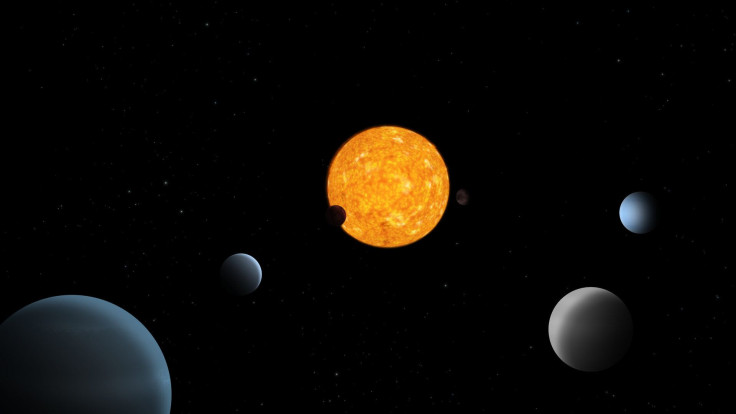
Scientists believe they have identified a planet other than the Earth that has the necessary ingredients to support life.
The New York Times reported that scientists have been studying a rocky planet named LHS 1140b since 2017. The planet is a several dozen light-years from our solar system.
According to the newspaper, the planet appears to have the right temperature for liquid water to exist. It also appears to have a helium-rich atmosphere.
"At this point, we have absolutely no evidence for life on the planet," Collin Cherubim, a planetary scientist who recently earned his Ph.D. from Harvard University, told the New York Times. "But we think all of the really important, essential ingredients are there."
A study published in the journal Science suggested that the planet might have an atmosphere.
"Helium absorption is detected in 2024 but not in 2025, indicating time-variable atmospheric escape. We interpret these results as indicating an upper atmosphere dominated by helium and depleted in hydrogen, with other volatile species trapped at lower altitudes, consistent with atmospheric fractionation models," the study states.
One of the authors of the study, Shreyas Vissapragada, told the New York Times that the difference in atmospheric escape was "a big shock," but also not fully "unexpected."
"We're watching the atmosphere of a planet, that is in a lot of ways similar to Earth, change in real time," Vissaprada told the Times. "I think that's pretty neat."
TIME reported that since 1992 more than 6,200 exoplanets - planets that are orbiting another star - have been discovered. Of those, scientists have attempted to find rocky planets that fit the right criteria to possibly sustain life.
According to TIME, in 34 years of study, only LHS 1140b has checked all the boxes scientists believe are needed to sustain life.
"My models do predict carbon dioxide to be the second most abundant gas, and carbon monoxide to be present, and also small amounts of O2 molecular oxygen," Cherubim told TIME. "From our climate modeling, we've also predicted a lot of water on this planet."
© Copyright IBTimes 2026. All rights reserved.