

America’s Oil Safety Net Is Running Out, Giving China More Influence Over U.S. Gas Prices


KEY POINTS
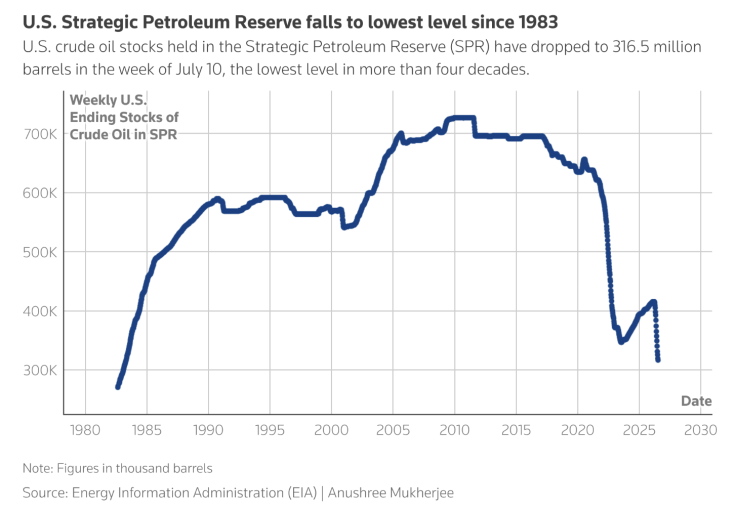
- America's Strategic Petroleum Reserve has fallen to its lowest level since 1983, limiting Washington's ability to stabilize oil markets.
- Beijing's temporary buying strike and inventory drawdowns acted as the primary damper on global oil prices.
As gas prices rise above $4 amid renewed fighting between the U.S. and Iran, the temporary cushions that suppressed price hikes are buckling, paving the way for a structural shift in global energy power politics where China—not the U.S.—is the dominant player.
One of those cushions is America's Strategic Petroleum Reserve (SPR) which hit its lowest levels since 1983. Years of aggressive drawdowns starting with the 2020 pandemic, accelerating during the 2022 outbreak of the Russia-Ukraine war, and continuing into the current conflict have taken a cumulative toll. "Now we have close to nothing left of the excess inventories... Market complacency around Hormuz flows is being severely tested," Amrita Sen, Founder and Director of Market Intelligence, Energy Aspects, told the Financial Times.
Private sector inventories are similarly depleted. Reuters reported Exxon Mobil Senior Vice President Neil Chapman's stark warning: "We're approaching unheard of inventory levels. I mean, really, really low levels. You can debate whether that's going to hit those really low levels in two weeks or three weeks. But once you get to that point, you'll see prices shoot up."
Overall, the world used up roughly 600-700 million barrels from oil reserves since the crisis began according to Sen.
A second major cushion that helped keep oil prices low was a series of surprising actions by China, the world's largest crude importer. Before the war began, China was estimated to have amassed between 1.2 billion and 1.5 billion barrels of oil in commercial and strategic reserves or about 100 days' worth of imports. After hostilities commenced, China sharply curtailed its oil purchases from abroad, cutting June imports by over 41% year-over-year while slashing exports of its refined oil products. This combination helped keep global oil demand lower at a time when supplies were disrupted, resulting in relative price stability instead of the steep increases predicted by many analysts.
As the conflict drags on for months or possibly even years, an important shift in geopolitical power and energy market dynamics is under way. With America's SPR dwindling, the decisions of China's policymakers to purchase, import, or export oil will increasingly influence what Americans pay at the pump for gas.
© Copyright IBTimes 2026. All rights reserved.