

China’s Economy Just Posted Its Slowest Growth Since 2022. Experts Say Beijing May Need a Stimulus Push
The weaker performance also placed economic growth below Beijing's full-year target range of 4.5% to 5%.

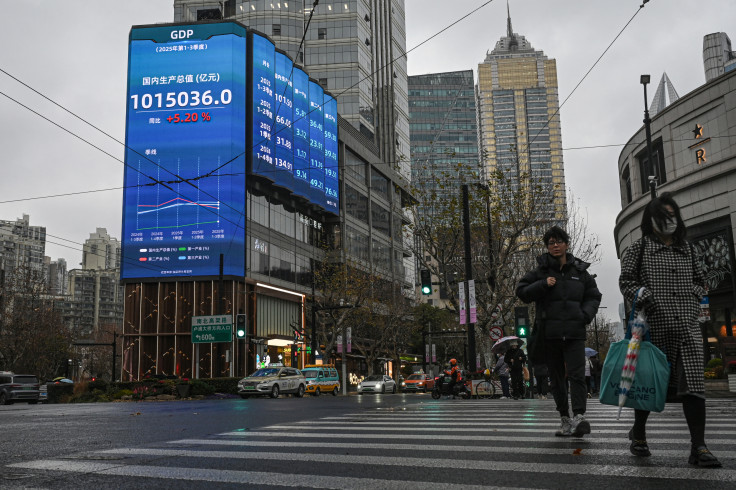
China's economy grew at its slowest quarterly pace since late 2022 in the second quarter of 2026, missing expectations and intensifying pressure on Beijing to introduce new stimulus measures.
According to data released Wednesday by China's National Bureau of Statistics, gross domestic product expanded 4.3% between April and June compared with a year earlier. The figure fell short of economists' expectations of 4.5%, according to a Reuters poll, and marked a slowdown from the 5% growth recorded during the first quarter.
The weaker performance also placed economic growth below Beijing's full-year target range of 4.5% to 5%, already the country's least ambitious goal in decades. Analysts say slowing domestic demand, ongoing property market weakness, and trade tensions with major partners are making it increasingly difficult for policymakers to sustain momentum.
"The disappointing growth suggests that stimulus measures will likely be ramped up in the third quarter," Tianchen Xu, senior economist at Economist Intelligence Unit, told CNBC. Xu expects Beijing to cut policy interest rates to encourage investment and increase infrastructure spending.
Investment has emerged as one of the economy's biggest weak spots. Urban fixed asset investment, which includes spending on real estate, infrastructure and manufacturing projects, fell 5.7% during the first six months of the year compared with the same period in 2025.
The decline was steeper than economists had anticipated and represented a further deterioration from earlier months. Xu attributed the worsening slowdown to local governments prioritizing debt restructuring over new projects while also facing a shortage of qualified infrastructure investments.
"Boosting infrastructure investment will be a key focus for stabilizing growth," he said.
Official data showed real estate investment plunged 18% during the first half of the year, while infrastructure investment declined 2.4% and manufacturing investment slipped 1.2%.
Sarah Tan, an economist at Moody's Analytics, said Beijing's efforts to reduce industrial overcapacity and end aggressive price competition are also discouraging private sector investment in the near term. While investment remained under pressure, consumer spending showed modest signs of improvement.
Retail sales rose 1% in June from a year earlier, recovering from a 0.6% decline in May and outperforming expectations that had called for another monthly contraction. May marked China's first monthly retail sales decline since late 2022, reflecting weak consumer confidence and heavy discounting by retailers.
Industrial production also surprised to the upside, increasing 5.3% in June compared with the previous year, accelerating from May's 4.5% pace and beating economists' forecasts.
China's economy continues to display a growing imbalance between strong manufacturing activity and weak domestic demand.
Industrial output and exports, particularly products tied to the global artificial intelligence boom, have remained resilient even as consumers remain cautious and private investment weakens amid the prolonged property downturn.
The National Bureau of Statistics acknowledged what it described as an "acute" mismatch between excess supply and sluggish demand and urged policymakers to strengthen both countercyclical and cross-cyclical economic adjustments.
Despite the disappointing headline growth, economists remain divided over whether Beijing will respond with major new stimulus. Zhiwei Zhang, president and chief economist at Pinpoint Asset Management, argued that strong first-quarter growth and resilient exports should keep China on track to meet its annual target, reducing the urgency for sweeping policy changes.
Exports remain one of China's strongest economic pillars. June exports recorded their fastest annual growth since late 2021, driven by global demand for semiconductors, computers, power equipment and other technology products tied to expanding AI infrastructure.
However, that export strength is also creating new geopolitical challenges. According to Macquarie chief China economist Larry Hu, China's trade surplus with the European Union widened 24% during the first half of the year, fueled largely by machinery and vehicle exports.
"Despite a three-month trade truce, the growing surplus keeps the risk of a China-EU trade conflict elevated," Hu said. Meanwhile, the labor market continues to present mixed signals.
China's official urban unemployment rate held steady at 5% in June, within the government's target of keeping unemployment below 5.5%.
However, a separate survey conducted by Tsinghua University economist Li Daokui estimated China's broader unemployment rate at 10.2% after including long-term unemployed workers who are no longer counted in official labor statistics.
Youth unemployment also remains elevated. Although the official youth jobless rate declined to 15.6% in May, more than half of China's estimated 24 million long-term unemployed are between the ages of 16 and 24.
© Copyright IBTimes 2026. All rights reserved.