

China’s Slowdown Intensifies: Retail Sales Rise Just 0.6% as Investment Tumbles
The figure fell short of the 1.5% growth expected by economists and marks another slowdown from the 1% gain recorded in June.

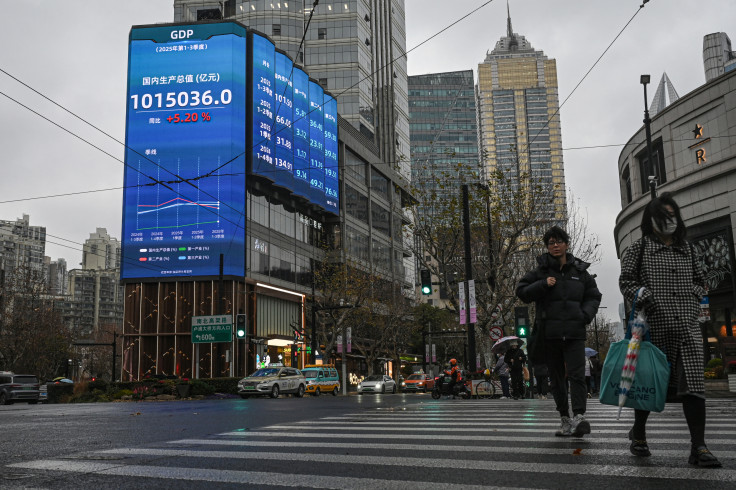
China's economy lost more momentum in July: consumer spending barely grew, investment fell at a faster pace and unemployment rising, increasing pressure on Beijing to provide more support for the world's second-largest economy.
Retail sales rose just 0.6% in July from a year earlier, according to data released Monday by China's National Bureau of Statistics. The increase fell well short of the 1.5% growth expected by economists and marked another slowdown from the 1% gain recorded in June, CNBC noted.
The weakness extended well beyond consumers. Urban fixed-asset investment, which includes spending on real estate, infrastructure and other major projects, contracted 6.7% in the first seven months of 2026 compared with the same period last year. Economists had expected a 6% decline.
The drop also accelerated from the 5.7% contraction reported during the first half of the year, highlighting the increasing strain on one of the traditional engines of China's economic expansion.
Industrial production, another area that has helped offset weak domestic demand, also disappointed. Output increased 4.5% in July from a year earlier, below expectations for a 4.8% gain and down from 5.3% growth in June.
Meanwhile, China's urban unemployment rate increased to 5.2% from 5% in June. The broad deterioration comes as Beijing struggles with a prolonged property downturn, weak consumer confidence and an increasingly severe imbalance between China's production capacity and domestic demand.
China's statistics bureau acknowledged the challenges, saying the country needs to "accelerate the transition to new growth drivers." Spokesperson Fu Linghui said geopolitical pressures and unusually high temperatures affected economic activity in July, while arguing that exports, emerging industries and government policies could still help China achieve its full-year growth target.
Consumer spending remains a particularly difficult problem. Nominal retail sales grew just 1.3% during the first half of 2026, compared with 5% during the same period last year. A government trade-in subsidy program initially encouraged consumers to bring purchases forward, but that effect has since become a drag on growth.
Weak borrowing provides another warning sign. New bank loans registered their largest monthly decline on record in July, typically a weak month for lending. Household borrowing, including mortgages, also contracted following a brief recovery in June.
China's continuing real estate crisis is central to the problem. Property investment plunged 19.2% during the first seven months of 2026. Infrastructure investment fell 3.6%, while manufacturing investment declined 1.7%.
High-tech investment provided one of the few bright spots, rising 5% from a year earlier. The category includes information services, aerospace and equipment manufacturing, areas Beijing has increasingly promoted as future economic growth engines.
The labor market is also raising concerns. While the official urban unemployment rate remains slightly above 5%, a private survey conducted by a team led by Tsinghua University economics professor Li Daokui estimated a broader unemployment rate of 10.2% in July.
The survey includes people unemployed for as long as two years who are no longer captured by China's official labor force survey. More than half of the roughly 24 million long-term unemployed identified in the research were between 16 and 24 years old.
Official youth unemployment was already 14.9% in June, its highest level for that month since authorities changed the methodology more than two years ago to exclude university students.
The increasingly weak numbers are fueling expectations that Beijing could respond with additional stimulus. Zhiwei Zhang, president and chief economist at Pinpoint Asset Management, said the July data showed "further downside risks" and increased his expectations for an interest-rate cut by the People's Bank of China.
© Copyright IBTimes 2026. All rights reserved.