Michael Saylor Just Sold Bitcoin at a Loss for the Third Time in 2026


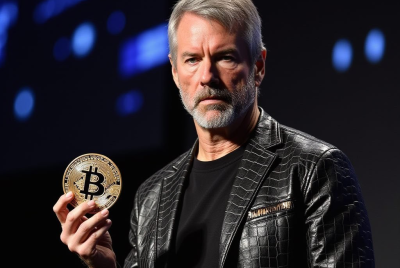
Bitcoin trades near $64,800 on August 7, and Michael Saylor picked this exact moment to reaffirm the most audacious goal in corporate finance: making Strategy the largest company on Earth by market capitalization.
The problem is what the filings say he did to get there.
In the same window, Strategy sold Bitcoin at a loss for the third time this year. The man who turned "never sell" into a religion is now, quietly, a net seller.
The World-Domination Math For Saylor
In an August 5 post and its Q2 call, Strategy laid out the plan: own the most capital in Bitcoin, target a 30% annual return on reserves, then issue the "strongest credit" to mint the "best equity."
Strategy currently holds 842,138 BTC, about 4.01% of all supply, against a market cap near $36 billion.
To dethrone Nvidia, MSTR would need roughly 140x upside, on the order of $5.26 trillion. Purely mathematical, and entirely dependent on Bitcoin cooperating. The messaging leans on the pitch CEO Phong Le keeps repeating:
Strategy is "the JPMorgan of the crypto economy." — Phong Le, CEO, Strategy
The Uncomfortable Truth: He's Selling
Here's what undercuts the empire talk. Strategy has now sold Bitcoin three times in 2026, offloading a combined 5,258 BTC for roughly $323 million.
The latest, 1,638 BTC between July 27 and August 2, went out at an average of $63,957, well below the firm's $75,419 cost basis. That's a sale at a loss.
An August 3 filing split the proceeds almost evenly: about $52.4 million toward STRC preferred dividends and $52.3 million to buy back those same shares. The prophet has an explanation:
"I never said Strategy would never sell its Bitcoin." — Michael Saylor, executive chairman, Strategy
He now frames "Never Sell Your Bitcoin" as personal advice for individuals, not a corporate promise, and insists he's never touched his own coins. Technically true. It's also a long way from "you do not sell your Bitcoin."

Follow the incentive and it gets clearer. STRC, designed to trade near its $100 par, cratered to $70 in June and now sits around $90.60, still below the level management said it needs to see before resuming meaningful Bitcoin buys.
Strategy hasn't purchased a single coin in roughly six weeks, instead raising $290.6 million through stock sales and lifting cash reserves to $4 billion.
Saylor even said the next trillion-dollar opportunity "isn't owning more Bitcoin," it's building a credit business on top of it. Bitcoin, for now, is secondary to defending the preferred stock.
Macro and Security Headwinds Pile On
The timing is brutal on two fronts. Bitcoin sits well below Strategy's cost basis, and MSTR trades near $94, down roughly 74% from its high, after Q2 swung to an $8.33 billion operating loss on mark-to-market accounting.
Meanwhile, a Fed official just floated a rate hike, and a volunteer group called Bitcoin Red Team surfaced nearly 5,000 potential vulnerabilities across the ecosystem's software stack, days after the Coldcard wallet exploit drained over $100 million. The base layer is fine. The plumbing around it clearly isn't.
So the debate lands where it always does with Saylor. Is this a visionary doubling down at the bottom while everyone panics, or a financing machine that has quietly forced its own architect to sell the one thing he spent five years telling the world to hold?
© Copyright IBTimes 2026. All rights reserved.
- Recommended For You