SpaceX Shares Have Pulled Back From Their Peak. TD Cowen Says AI Compute Could Drive A Rebound.
SpaceX's own filings show the company has already signed multibillion-dollar agreements to lease AI infrastructure to customers including Anthropic.

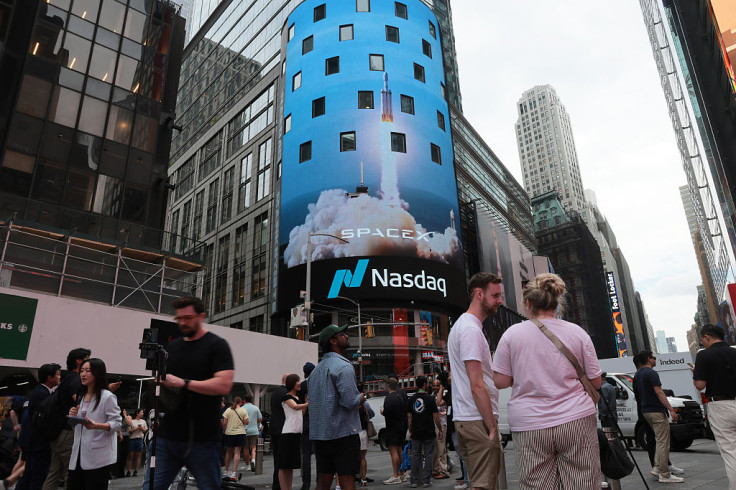
SpaceX shares could recover from their sharp retreat from post-IPO highs as the company's growing artificial intelligence computing business adds another major source of revenue alongside Starlink and launch services, according to TD Cowen.
Analyst John Blackledge initiated coverage of SpaceX with a buy rating and a $200 price target, implying roughly 37% upside from Monday's closing price of $145.47, according to CNBC, which reviewed the firm's research note. The stock was climbing further on Tuesday, up by more than 2% at 3:28 p.m. ET.
SpaceX began trading publicly in June after pricing its initial public offering at $135 a share. The company sold more than 638 million shares after underwriters exercised their full allotment option, generating approximately $85.7 billion in net proceeds, according to SpaceX's filing with the U.S. Securities and Exchange Commission.
Shares subsequently climbed as high as $225.64 before retreating. They traded above $148 on Tuesday, still above the IPO price but substantially below that post-listing peak.
TD Cowen's call centers heavily on a part of SpaceX's business that has moved beyond rockets and broadband satellites: leasing large amounts of computing capacity to companies developing artificial intelligence models.
Blackledge expects terrestrial AI compute leasing to become SpaceX's fastest-growing revenue stream and account for a majority of the company's overall revenue by the first quarter of 2027, CNBC reported, citing the analyst's note.
He estimated that SpaceX's terrestrial computing capacity could rise from about 2.1 gigawatts in 2026 to 6 gigawatts by the end of 2027. TD Cowen also estimates the company could generate about $8.1 billion in AI compute leasing revenue during the fourth quarter of 2026 and exit December with roughly $41 billion in annual recurring revenue from the business.
Those projections are TD Cowen estimates, but SpaceX's public filings already show the company has signed substantial contracts around its computing infrastructure.
SpaceX disclosed in its IPO prospectus that it entered cloud services agreements with Anthropic in May covering computing capacity across its Colossus and Colossus II infrastructure.
The agreements provide Anthropic access to roughly 325,000 Nvidia GPUs, along with large-scale CPU, storage and networking infrastructure built for AI workloads, according to the company's SEC prospectus. Anthropic agreed to pay SpaceX $1.25 billion a month through May 2029, with lower payments during the initial capacity ramp in May and June 2026.
SpaceX told investors in its IPO materials that it could use the same infrastructure for its own AI applications while allocating selected capacity to outside customers. The company's prospectus also identified expansion of AI compute infrastructure as one of the uses for proceeds from its public offering.
Blackledge said SpaceX currently has four customers leasing or preparing to lease AI computing capacity this year, including Anthropic and Alphabet, according to CNBC. TD Cowen described the imbalance between demand for AI computing power and available supply as the company's biggest near-term revenue opportunity.
SpaceX has also increasingly highlighted AI infrastructure as a central part of its broader strategy. Its website now includes "Developing Orbital AI Compute" among its major business areas, alongside launch services, Starlink and human spaceflight.
The company has described a longer-term plan involving compute infrastructure both on Earth and potentially in orbit, although TD Cowen's near-term estimates focus on terrestrial capacity.
The analyst's report came a day after another milestone for SpaceX.
Starship Flight 14 launched from Starbase, Texas, on Monday in the vehicle's first mission designed to enter Earth orbit. The flight also included plans to deploy 26 next-generation Starlink V3 satellites, according to SpaceX's official mission page.
SpaceX has positioned Starship as a fully reusable transportation system intended to carry large amounts of cargo to Earth orbit and eventually support missions to the Moon and Mars. Its larger payload capacity is also important to the company's plans for deploying future generations of Starlink satellites and, eventually, space-based computing infrastructure.
TD Cowen also pointed to Starship as another contributor to SpaceX's longer-term revenue mix. Blackledge said the rocket could support more complex government missions, including lunar and Mars-related work, and expects development-related revenue eventually to exceed traditional launch-services revenue, according to CNBC.
The company has already said Starship will play a significant role in expanding the capacity of Starlink. SpaceX said in May that each launch carrying its newer Starlink V3 satellites could add more than 20 times the network capacity of current Falcon missions carrying V2 satellites.
© Copyright IBTimes 2026. All rights reserved.
- Recommended For You