

Wison New Energies Signs EPCIC Contract for Baleine Phase 3 FPSO, Marking Milestone in Its Floating Production Push
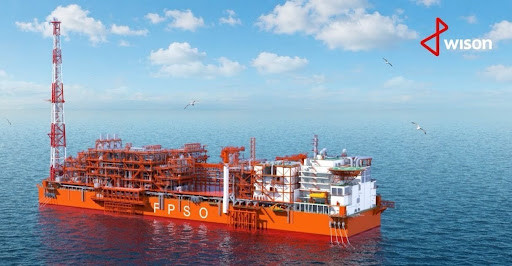
Wison New Energies has signed the engineering, procurement, construction, installation and commissioning (EPCIC) contract for the floating production, storage and offloading (FPSO) facility that will serve Eni's Baleine Phase 3 offshore field in Côte d'Ivoire, with Altera Infrastructure as owner and operator of the FPSO facility.
The deal marks a significant milestone for Wison in the FPSO sector, demonstrating the company's capability and long-term commitment to this growing market. As FPSOs become an increasingly important solution for offshore resource development, Wison has built the integrated EPCIC capabilities and in-house fabrication capacity needed to participate in this evolving sector.
The Baleine Phase 3 FPSO will be substantial. It is designed to process up to 90,000 barrels of oil per day, 80,000 barrels of produced water per day and 160 million standard cubic feet of natural gas daily, operating in water depths between roughly 800 and 1,200 meters. The unit itself will stretch approximately 308 meters, with a breadth of 57 meters and a depth of 29.8 meters, and it carries a design life of at least 20 years.
What makes this contract notable is primarily its scope. Wison has been involved in Baleine Phase 3 since the front-end engineering design stage, meaning the company carried the project from early design work all the way through to full EPCIC execution. That end-to-end delivery model provides operators with greater certainty by reducing interface risks associated with fragmented execution.
Since entering the FPSO market in 2022, Wison has developed a diversified FPSO portfolio covering benign-environment FPSO, gas-type FPSO and harsh-environment FPSO solutions, enabling the company to support a broad range of offshore development requirements across different operating conditions. The Baleine Phase 3 contract represents a further step in Wison's expansion in the global FPSO market.
"This contract underscores the confidence of international clients in our engineering capabilities, project execution and supply chain management," said Cheng Yuanyun, CEO of Wison New Energies, adding that the company would apply its project management framework to ensure successful delivery.
That confidence is rooted in what Wison has built into its FPSO product line technologically. The company's most notable recent advance is its low-emission smart FPSO, unveiled at the FPSO World Congress 2025 in Singapore, which reframes how a floating production facility can operate in a smarter, more efficient and lower-emission way.
Working with classification society Bureau Veritas (BV), Wison has embedded advanced digital technologies and AI-enabled capabilities directly into its FPSO systems, including data infrastructure, machine learning, and structural hull monitoring, rather than treating those as add-ons. In practice, that means the facility's onboard AI continuously analyzes data streaming in from thousands of sensors across the facility, learning what normal operation looks like so it can flag irregular vibrations, temperature spikes or pressure changes before they turn into equipment failures.
Wison pairs that sensor network with digital twin technology, a virtual replica of the FPSO that runs in parallel with the physical unit. Engineers can use the digital twin to test operating scenarios and optimize maintenance schedules without ever interrupting production, and if the twin shows a pump should be running at a certain efficiency while the real unit is lagging, maintenance can be scheduled before a breakdown occurs.
Structural hull monitoring provides another layer of operational insight, watching continuously for unexpected flexing or cracking in the facility's hull so that operators can act on targeted inspections rather than waiting for a costlier failure. In the complex maritime environments where FPSOs operate, like the one to which Baleine Phase 3 is headed, that kind of predictive capability is not a luxury. It is what keeps a 20-year design life on schedule and on budget.
The maturity of this approach was recently recognized when Wison's Smart FPSO Machine Learning System received Approval in Principle (AiP) from Bureau Veritas (BV).
Wison has extended this approach through partnerships with technology firms including SUPCON and Siemens Energy, aimed at pushing FPSO operations toward greater autonomy and efficiency. The company has also built sustainability directly into its floating platforms designs that incorporate combined-cycle gas turbine technology and carbon capture, utilization and reinjection systems. Supported by its in-house fabrication yards and modular construction capabilities, Wison can fabricate large-scale facility modules in controlled environments, enabling efficient integration and reliable delivery of complex floating energy facilities.
With operations spanning Houston, London, Singapore and Shanghai, Wison is positioning the Baleine Phase 3 contract as further proof that its FPSO, technology included, is built for exactly this kind of global, long-life offshore development.
© Copyright IBTimes 2026. All rights reserved.