Xi Jinping Is Visiting The U.S. Soon. Washington May Wait To Announce Any Tariffs Until After He Leaves.
Trump also will have more latitude in proposing new tariff levels for China thanks to recently passed legislation.


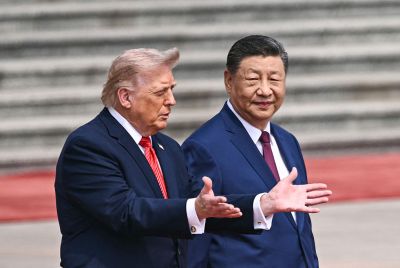
The U.S. might wait to announce any new tariffs against China and other countries until after a summit next week between President Trump and China's Xi Jinping.
Citing unnamed sources Bloomberg News reported that Trump was likely to wait until after the summit to announce any decision, hoping to preserve some leverage during their talks next week.
The outlet went on to note that Trump previously has used the threat of tariffs as a negotiating ploy. The administration has been preparing a trade report regarding supposed excess capacity that it might use to justify a 7.5 percent tariff on Chinese goods.
Trump also will have more latitude in proposing new tariff levels for China thanks to recently passed legislation. The legislation imposes new sanctions on Russia as a punishment for its continued war and invasion of Ukraine. However, the measure also allows Trump to issue tariffs of up to 100 percent on countries that purchase Russian oil and gas.
Among Russia's biggest customers is China. In fact, the potential for tariffs against China and India was mentioned in the aftermath of the bill's passage this week.
"To Vladimir Putin, we have your number," Connecticut Democratic Senator Richard Blumenthal said. "Your economy is reeling. We're going to throttle your war machine. To China and India, to you, you better clean up your act. Buy your oil and gas from somewhere else."
Although the measure, which has passed the Senate and the House, allows Trump to implement robust tariffs against what lawmakers refer to as Russian enablers, U.S. Trade Representative Jamieson Greer would have the final say on tariff levels.
Whether Trump will quickly make use of the new law, or simply use it to pressure Xi remains to be seen.
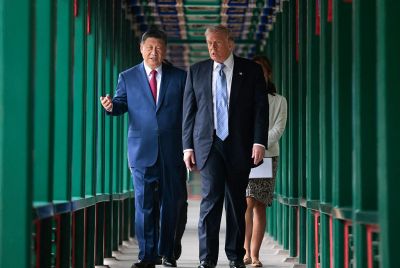
Bloomberg reported that the visit will be Xi's first since 2023, when he met with President Biden. The news service reported that U.S. and Chinese negotiators are expected to meet over the weekend and work out a potential deal prior to Xi's visit.
Earlier this year, much of Trump's original tariff policy was undone by the U.S. Supreme Court. In that instance, Trump had used the 1977 International Emergency Economic Powers Act (IEEPA) to implement sweeping tariffs unilaterally. Since then, he has been looking for other avenues to implement the tariffs he wanted legally.
For example, when Trump imposed tariffs on Canada earlier this year, he cited section 338 of the Tariff Act of 1930. That law gives the president power to impose tariffs if it is found that another country has discriminated against U.S. goods.
According to Bloomberg, the Trump administration began evaluating trade partners in March under Section 301 of the Trade Act of 1974, looking at the issue of excess capacity. Essentially, the claim is that some countries use market manipulation - subsidies, suppressed wages - to maintain high, excess production and flood markets with goods that are priced below market.
"Capacity issues should be viewed in a comprehensive and fair manner, and should not be used as a pretext for protectionism," Huang Ling, a spokesperson for China's Ministry of Commerce, told Bloomberg. "We will continue to closely follow and comprehensively assess subsequent US moves and reserve the right to take all necessary measures."
© Copyright IBTimes 2026. All rights reserved.
- Recommended For You