A Fed Member Supported The Latest Rate Hike. She Says Chances Of Elevated Inflation Are ‘Notably Higher’
"With the labor market on a better footing, monetary policy can focus on a timely return to price stability, especially after five and a half years of too high inflation," Boston Fed President Susan Collins said.


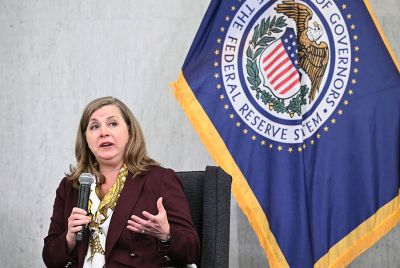
Boston Federal Reserve President Susan Collins said she supported last week's rate hike by the Federal Open Market Committee (FOMC) after the most recent data led her to conclude inflation is set to continue running above target without intervention.
In a LinkedIn post, Collins said she now sees "an increased likelihood of future scenarios in which inflation remains notably above 2 percent."
She went on to say that, on the flip side, "labor market conditions seem a bit stronger overall, and the unemployment rate remains low" even though "experiences vary considerably by place and sector."
"With the labor market on a better footing, monetary policy can focus on a timely return to price stability, especially after five and a half years of too high inflation. A somewhat more restrictive federal funds rate will help ensure that inflation durably returns to target," she claimed.
The Fed delivered the widely expected rate hike last week in a unanimous decision. Fed chair Kevin Warsh also struck a hawkish tone in his press conference following the decision, saying the FOMC's "predominant focus is on the price stability side of our mandate." "The plain fact is that inflation is too high, and has been for too long," he added.
Warsh went on to say that "this summer's inflation readings do not tell me that underlying trends have meaningfully improved," as several categories within the recent inflation readings are still above 3% on a six-and 12-month basis.
Core inflation rose more than expected last month, rising 0.3%. The figure was 0.1 percentage points more elevated than forecasts. The annual rate clocked in at 2.4%, as the Dow Jones consensus expected.
The FOMC said in its statement that "inflation remains elevated" and the decision "will support a timelier return to the Committee's 2 percent goal." Most officials also projected another rate hike by the end of the year.
Elsewhere, the document noted that "economic activity is expanding at a solid pace" and, "while uncertainty remains elevated owing, in part, to geopolitical developments, domestic spending has been resilient."
"Productivity growth is strong, and capital investment is robust. Job gains have kept pace with the workforce, and the unemployment rate has changed little," the FOMC added.
A survey conducted before the decision shows that market participants expect the central bank to take a more hawkish stance than before as price pressures continue, particularly in the energy industry.
The poll, conducted by CNBC, shows that 86% of respondents now expect one hike in 2027 and 55% more than one. That compares to 46% who expected a hike ahead in the last poll.
About three quarters of respondents expect the impact to translate to broader prices. However, the growth outlook has remained largely unchanged at 2.25% this year and in 2027. Recession concerns stayed at 29% over the next 12 months.
© Copyright IBTimes 2026. All rights reserved.
- Recommended For You